
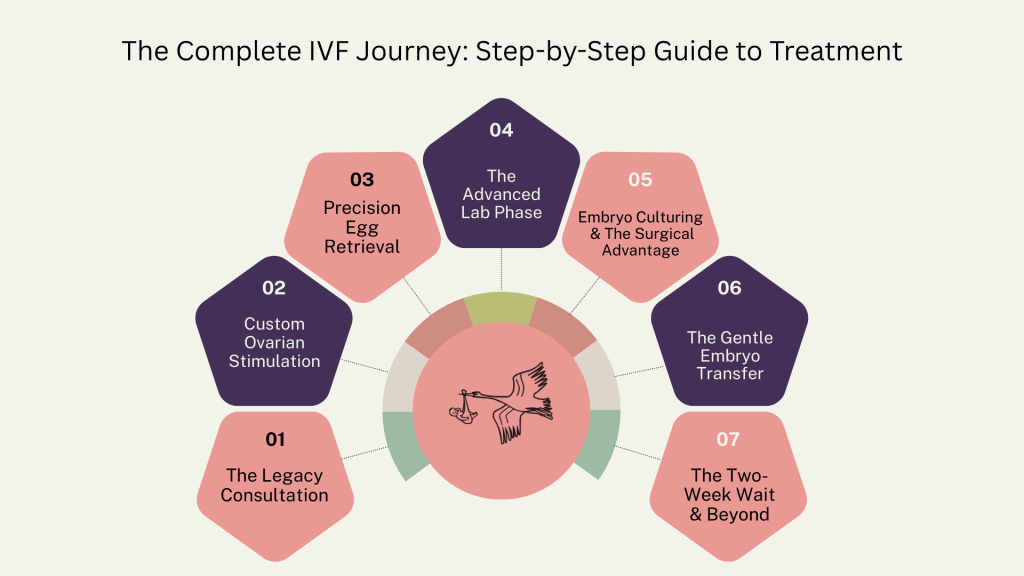
Starting an IVF journey is not just a medical decision — it is an emotional commitment filled with hope, courage, and trust. At Disha Fertility, every step is designed with precision, compassion, and decades of expertise from Dr. Asha Baxi and Dr. Dhaval Baxi. Their combined legacy blends advanced reproductive science with individualized care, ensuring that each couple receives a treatment plan tailored uniquely to them.
Step 1: The Legacy Consultation—Diagnostic Excellence
Every successful IVF cycle begins with clarity, and the first step is a comprehensive, unhurried fertility evaluation designed to understand your unique journey. During this detailed consultation, your complete medical, surgical, hormonal, and lifestyle history is carefully reviewed to uncover the true root cause of infertility rather than applying a standardized treatment approach. This phase includes advanced hormonal mapping, high-resolution ultrasound scans, ovarian reserve testing such as AMH and AFC, detailed semen analysis, and thyroid and metabolic screening to ensure no underlying factor is overlooked. Each investigation adds an essential layer of insight, helping create a precise diagnosis. The goal is simple yet powerful — to understand why conception has not happened yet. Many couples arrive after undergoing incomplete assessments elsewhere, but here the emphasis is on diagnostic accuracy, because when the diagnosis is clear and scientifically sound, the treatment plan becomes targeted, strategic, and significantly more effective.
Step 2: Custom Ovarian Stimulation – Designed for Your Body
No two women respond to fertility medications in the same way, which is why ovarian stimulation must be carefully customized. Factors such as age, hormone levels, ovarian reserve, and overall medical history play a crucial role in determining the right protocol. During this stage, hormonal injections are administered to encourage the ovaries to produce multiple mature eggs instead of the single egg that develops naturally each month. Follicle growth is closely monitored through regular ultrasounds and blood tests, allowing medication doses to be adjusted in real time based on how your body responds. With extensive experience, Dr. Asha Baxi carefully balances the goal of achieving optimal egg quality while prioritizing patient safety and minimizing risks like OHSS (Ovarian Hyperstimulation Syndrome). Rather than aggressively overstimulating the ovaries, the focus remains on intelligent, controlled stimulation that supports healthy egg development without compromising overall well-being. This phase usually lasts 8–12 days and involves consistent monitoring to ensure synchronized and optimal follicular growth before moving to the next step.
Step 3: Precision Egg Retrieval—A Critical Milestone
Once the follicles are in the state of perfect maturity, a well-timed trigger shot is given to the patient in order to prepare the eggs for the procedure. This is a crucial step in the entire IVF procedure because the eggs are collected at the perfect time for fertilization. The procedure of egg collection is a simple procedure and is performed in 15-20 minutes with the help of light sedation. The procedure is completely painless and comfortable for the patient. The eggs are collected from the ovaries using a fine needle with the help of ultrasound imaging. At this point in the procedure, the eggs are extremely delicate and sensitive. Therefore, the entire procedure must be carried out in a sterile atmosphere because any contamination or stress on the eggs may directly influence the fertilization procedure. The procedure is a major milestone in the entire IVF procedure.
Step 4: The Advanced Lab Phase – Where Science Meets Life
Following retrieval, the focus shifts to the embryology laboratory, where science plays a transformative role. In a highly controlled, temperature-regulated environment, the collected eggs are assessed for maturity while sperm samples are carefully prepared to select the healthiest and most motile sperm. Fertilization is then performed using either conventional IVF techniques or advanced methods such as ICSI (Intracytoplasmic Sperm Injection), particularly in cases of male infertility, where a single healthy sperm is precisely injected into an egg to enhance fertilization chances. Advanced incubators replicate the natural conditions of the human body, allowing embryos to develop in a stable and protected setting. Every embryo is monitored closely throughout its growth, as even minor environmental fluctuations can influence development. The quality and precision of the laboratory environment therefore become a cornerstone of overall IVF success.
Step 5: Embryo Culturing & The Surgical Advantage
After fertilization, embryos are cultured for several days, typically until Day 5, when the most viable ones reach the blastocyst stage — a developmental phase associated with higher implantation potential. However, successful IVF depends not only on embryo quality but also on uterine receptivity. If underlying conditions such as uterine fibroids, polyps, scar tissue, or endometriosis are identified, corrective procedures may be recommended prior to embryo transfer to optimize the uterine environment. Surgical expertise in fertility-enhancing procedures plays a vital role in addressing these concerns and improving implantation rates. The guiding philosophy remains clear and evidence-based: a healthy embryo combined with a healthy, receptive uterus significantly increases the chances of a successful pregnancy.
Step 6: The Gentle Embryo Transfer – The Most Crucial Moment
Embryo transfer is often considered the most emotional and hopeful step of the IVF journey. Using ultrasound guidance, the highest-quality embryo is gently placed into the uterus through a thin, flexible catheter. The procedure takes only a few minutes, requires no anesthesia, and is entirely non-surgical. While it may appear technically simple, embryo transfer demands exceptional precision and a soft, atraumatic technique to avoid disturbing the uterine lining. Following the transfer, patients rest briefly before resuming normal daily activities with basic precautions. At this point, the carefully orchestrated medical process transitions into nature’s hands, allowing implantation to occur naturally within the prepared uterine environment.
Step 7: The Two-Week Wait & Beyond – Emotional and Hormonal Support
The 10–14 days after embryo transfer, often called the “two-week wait,” can feel emotionally intense and longer than the entire treatment itself. During this period, hormonal medications are continued to support implantation and early pregnancy development. Patients receive detailed guidance regarding diet, activity levels, and precautions, while communication remains open for any concerns or questions. Anxiety and anticipation are completely natural during this stage, and ongoing emotional reassurance becomes just as important as medical support. Finally, a blood test is performed to confirm pregnancy. Regardless of the outcome, compassionate care continues — for positive results, early pregnancy monitoring begins, and if the cycle is unsuccessful, every aspect of the treatment is carefully reviewed and refined to optimize the strategy for the next attempt.
Why a Structured IVF Approach Matters
IVF is far more than a sequence of medical procedures — it is a carefully coordinated process where every stage builds upon the previous one. True success depends on a correct and thorough diagnosis, customized stimulation protocols tailored to individual biology, laboratory precision that protects and nurtures developing embryos, surgical expertise when uterine optimization is required, and consistent emotional support throughout the journey. Each element plays a critical role, and even small gaps in evaluation or execution can influence outcomes. A generalized, one-size-fits-all approach may overlook subtle but important factors that affect implantation and pregnancy. In contrast, a structured and personalized pathway ensures that no detail is missed, treatment decisions are evidence-based, and patients move forward with clarity and confidence. When the process is systematic and individualized, it not only improves success rates but also strengthens trust and reassurance at every step.
Conclusion
The IVF journey is a delicate blend of science, timing, precision, and trust. From the first consultation to the final pregnancy test, every stage requires both clinical expertise and emotional sensitivity. At Disha Fertility, the approach is never mechanical — it is deeply personal and thoughtfully structured. Diagnostic excellence forms the foundation of treatment decisions, customized ovarian stimulation ensures safety and optimal egg quality, advanced embryology techniques enhance fertilization potential, and surgical precision helps create the ideal environment for implantation. Alongside these medical milestones, continuous guidance and compassionate support ensure that no couple feels alone during the process. Parenthood may begin with biology, but it flourishes through dedication, strategy, and shared commitment. With the right expertise and empathetic care, the IVF journey becomes not just a treatment plan but a hopeful and empowering path toward building a family.
Frequently Asked Questions (FAQs)
1. How long does a complete IVF cycle take?
Ans. A typical IVF cycle takes about 4–6 weeks from consultation to pregnancy test. Ovarian stimulation lasts around 10–12 days, followed by retrieval, fertilization, and embryo transfer.
2. Is IVF painful?
Ans. Most steps are minimally invasive. Egg retrieval is performed under sedation and is painless. Embryo transfer is quick and does not require anesthesia.
3. What are the chances of IVF success?
Ans. Success rates depend on age, ovarian reserve, sperm quality, and uterine health. A personalized protocol significantly improves outcomes.
4. What is ICSI and when is it needed?
Ans. ICSI (Intracytoplasmic Sperm Injection) is used in cases of male infertility or previous fertilization failure. A single sperm is injected directly into the egg to aid fertilization.
5. Can lifestyle affect IVF results?
Ans. Yes. Maintaining a healthy weight, avoiding smoking and alcohol, managing stress, and following medical advice improve outcomes.